
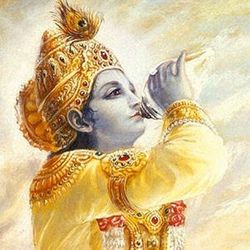

18_Bhagavad Gita: Chapter 2, Verse 39 to 44
ذڪۦۘۘۘﺮﯾۦۘۘۘﭑټﻗۦۘ
Description
<p> According to the <em>Nirukti, </em>or the Vedic dictionary, <em>sankhya</em> means that which describes phenomena in detail, and <em>sankhya </em>refers to that philosophy which describes the real nature of the soul. And <em>yoga </em>involves controlling the senses. Arjuna's proposal not to fight was based on sense gratification. Forgetting his prime duty, he wanted to cease fighting because he thought that by not killing his relatives and kinsmen he would be happier than by enjoying the kingdom by conquering his cousins and brothers, the sons of Dhrtarastra. In both ways, the basic principles were for sense gratification. Happiness derived from conquering them and happiness derived by seeing kinsmen alive are both on the basis of personal sense gratification, for there is a sacrifice of wisdom and duty. Krsna, therefore, wanted to explain to Arjuna that by killing the body of his grandfather he would not be killing the soul proper, and He explained that all individual persons, including the Lord Himself, are eternal individuals; they were individuals in the past, they are individuals in the present, and they will continue to remain individuals in the future, because all of us are individual souls eternally, and we simply change our bodily dress in different manners. But, actually, we keep our individuality even after liberation from the bondage of material dress. An analytical study of the soul and the body has been very graphically explained by Lord Krsna. And this descriptive knowledge of the soul and the body from different angles of vision has been described here as <em>sankhya, </em>in terms of the <em>Nirukti </em>dictionary. This <em>sankhya </em>has nothing to do with the <em>sankhya </em>philosophy of the atheist Kapila. Long before the imposter Kapila's <em>sankhya, </em>the <em>sankhya </em>philosophy was expounded in the<em> Srimad-Bhagavatam </em>by the true Lord Kapila, the incarnati
Uploader
eddie.storm
Episodes
18_Bhagavad Gita: Chapter 2, Verse 39 to 44
ذڪۦۘۘۘﺮﯾۦۘۘۘﭑټﻗۦۘ