
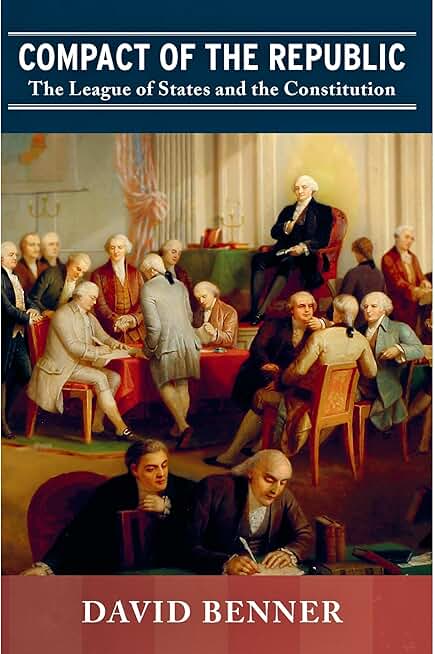

Compact of the Republic: The League of States and the Constitution
Eliza Giovanni
Описание
The United States Constitution was a concerted response to an age of tyrannical kings and highly centralized government. As history reveals, such political authority had to be challenged directly – by local units and causes – to preserve liberty and ensure public happiness. Compact of the Republic demonstrates that the Constitution did not impose a nationalist, superlative central government, and was not ratified by “one American people” in the aggregate. Instead, the document was the product of a multi-party arrangement, where the states remained the masters of their own creation and the pillars of the federal system. As the standard defense of the compact theory of the union, this account throws a wrench into the wheel of contemporary legal thought. In Compact of the Republic, historian David Benner: *Reveals that representatives were assured that delegated power could be reclaimed by the states following acts of federal overreach and usurpation *Explains the historical foundation behind the Bill of Rights, and traces the limitations on government to the actions of malevolent kings *Proves the Constitution acknowledges the states in the plural, as a collection of sovereign societies with varied interests *Demonstrates that the "elastic clauses" were clearly explained during the ratification campaign, and leave no room for modern reinterpretation *Describes how the federal judiciary now overturns state laws it has no jurisdiction over, to the contrary of its original scope of power *Explains why Thomas Jefferson and James Madison believed that unconstitutional federal laws had to be opposed, nullified, and obstructed by the states *Illustrates that ratification was secured only by convincing opponents of the Constitution that the document would produce a nominal general government with limited, enumerated powersRead more
Похожие работы

Эпизоды (11)
Chapter 1: The Compact: An Outlawed Perspective
Chapter 2: The War of Independence as a Constitutional Crisis
Chapter 3: Essential Constitutional Antecedents
Chapter 4: The Philadelphia Convention and State Ratification Conventions
Chapter 5: The Jeffersonian Tradition
Chapter 6: An Exceptional War of Independence
Chapter 7: The Legacy of Alexander Hamilton and John Marshall
Chapter 8: The "Sweeping Clauses” – What Do They Really Mean?
Chapter 9: The Problem and the Proper Recourse
Documents