
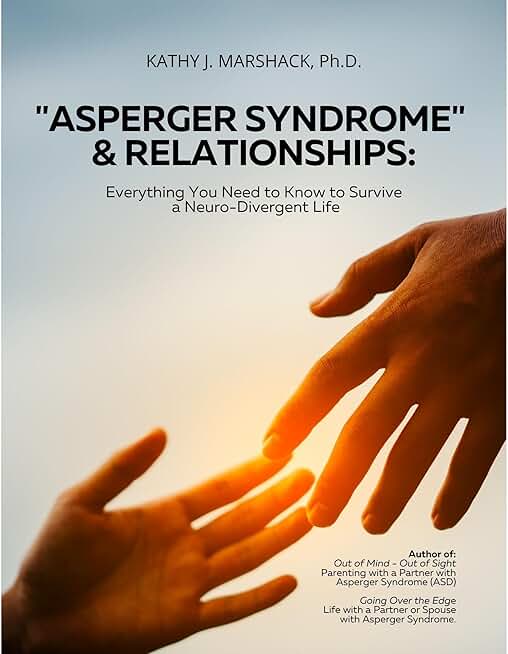

"Asperger Syndrome" & Relationships: Everything You Need to Survive a NeuroDivergent Life
peggie love
Description
______________________________________________RECOMMENDATIONS AND PRAISE FROM READERS______________________________________________“Kathy, you have opened doors that help me to be more gracious and accepting toward my husband’s struggles without becoming an ‘object.’”“Amen. Thank, you Dr. Kathy. [From] Xoxox [who is] feeling encouraged for the first time in days.”“Wow!! This was awesome, so well explained!! I found myself remembering how it feels with similar ‘missed’ understandings by my [Autistic] partner. It feels like he misses 99.9 percent of me, just can’t get into my head. . . Not sure he even knows I have a mind, except when I tell him.”“Thank you! Your [blog] post felt like a tall glass of water after 10 years in a drought. [I’m] expecting someday you will be nominated for a Nobel Peace Prize.”_____________________“Bad-ass” is how clients and colleagues refer to Dr. Kathy Marshack. She investigates in-depth, then explains the nature of relationships between people who have“Asperger Syndrome”and are on the Autism Spectrum and those who are not. She doesn’t hold back!Her casual writing style both engages and informs readers. The author begins the book with an explanation of unfamiliar“Aspergian”nomenclature,such as “NeuroTypical” (NT) and “Empathy Dysfunction” (EmD), a term coined by Dr. Marshack. The term, “NeuroDiverse” (ND) describes the unique workings of a brain that is different from those with typical neurological development or functioning; hence, the second descriptive term, “NeuroTypical.” A relationship between a person who is NeuroDiverse and another who is NeuroTypical is considered “NeuroDivergent.”The author, a well-established and prolific writer on Empathy and Empathy Dysfunction, explains that Empathy is more than being sensitive: It is the ability to hold on to your thoughts and feelings while acknowledging the thoughts and feelings of another person.“Aspies,”the author adds, "struggle to integrate these parts. This leaves them unable to relate to cues, conversation pauses, ambiguity, me
Diffuseur
peggie love
Œuvres associées

Épisodes (14)
Chapter 1: “Asperger Syndrome” & Relationships
Chapter 2: “Asperger Syndrome:” What’s In A Name?
Chapter 3: Empathy: “Asperger’s” Style
Chapter 4: The Silent Treatment
Chapter 5: PTSD and OTRD are Common, But Not Mandatory
Chapter 6: Living with an “Aspie” Partner
Chapter 7: How to Speak to your “Aspie” so They Listen and Understand
Chapter 8: How Can You Tell if It’s Abuse or “Asperger’s”
Chapter 9: Antidote to Regret, Grief and Self-Recrimination
Chapter 10: The Art of Detachment – Essential for “Asperger” Relationships