
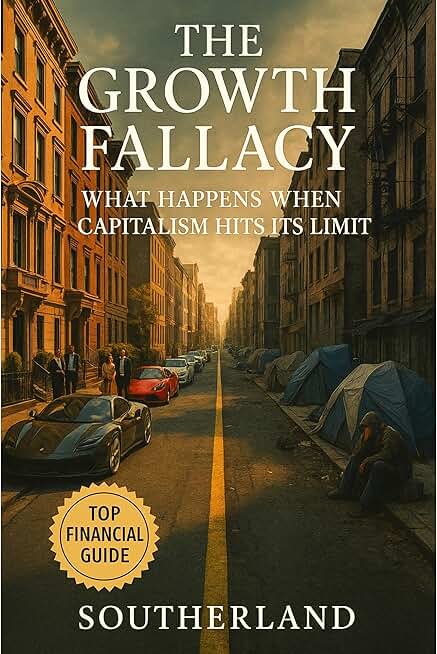

The Growth Fallacy: What Happens When Capitalism Hits Its Limit: How Capitalism Breaks When Growth Stops—and What Comes Next
Sainabou Macauley
Description
The Growth Fallacyis a clear-eyed examination of the world’s most dangerous economic illusion: that perpetual growth is possible on a finite planet. With scalpel-like precision, this book dissects the structural dependence of modern capitalism on constant expansion—and what happens when that expansion stalls.From GDP worship and corporate mandates to ecological ceilings and demographic contractions, each chapter reveals how growth isn't just a byproduct of capitalism—it's the engine. And when the engine fails, everything built around it begins to fracture: pensions, public services, markets, innovation, even democracy itself.Drawing on hard data, real-world case studies, and decades of economic evidence,The Growth Fallacyshows how nations facing stagnation veer toward financial speculation, political extremism, and ecological exhaustion. It exposes the myths behind green growth, the false promises of climate tech, and the dangerous feedback loops linking debt, inequality, and collapse.But this isn’t just a diagnosis—it’s a reckoning. The book also explores what a post-growth world could look like: economies based on sufficiency instead of acceleration, prosperity redefined through well-being, and political systems capable of managing contraction without collapse.This is not a call for utopia. It's a survival manual for reality. If you're ready to confront the end of business-as-usual—and want a framework for what comes after—it starts here.Read more
Related Works

Episodes (31)
Chapter 1: The Engine That Always Needs More
Chapter 2: GDP: The God Metric
Chapter 3: Growth or Die: The Corporate Mandate
Chapter 4: Why Capitalism Can't Plateau
Chapter 5: Debt and the Growth Ponzi Scheme
Chapter 6: Productivity Hits the Wall
Chapter 7: Demographics Don’t Lie
Chapter 8: The End of Cheap Energy
Chapter 9: Environmental Limits and the Growth Ceiling
Chapter 10: Financialization as a False Proxy